- Dec 4, 2025
Western Red Cedar (Thuja plicata): The Living Cathedral of the West
- Brighid An Lasair
- Herbs, Sabbats, Deities, Wellness, Magical Properties, Magical Correspondences, Magical Practices
- 0 comments
A Sacred, Storied, and Spirit-Bearing Tree of Healing, Protection, and Ancestral Memory
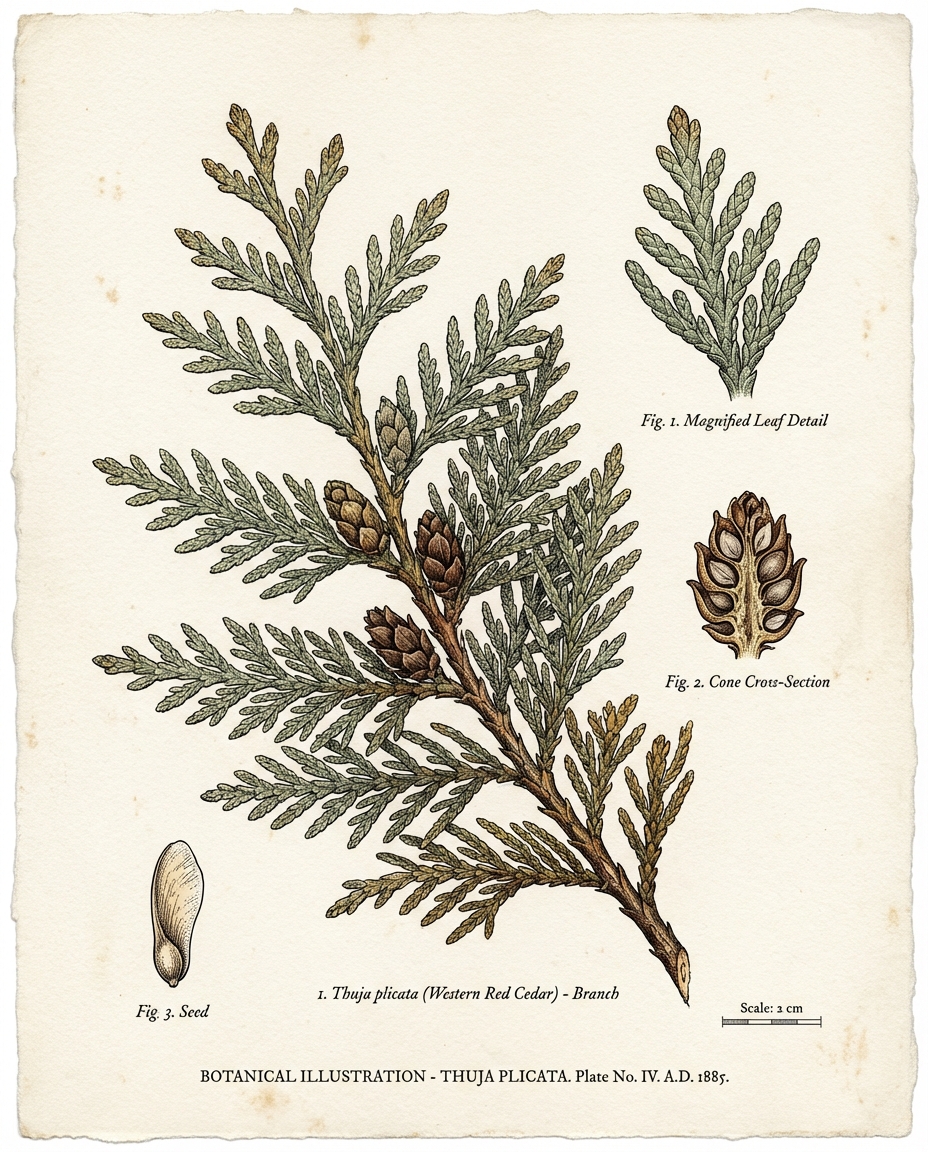
Western Red Cedar is not merely a tree. In the Pacific Northwest, it is a world unto itself, a sanctuary where memory gathers like mist and spirit moves with quiet authority. Known widely as The Tree of Life, Thuja plicata has been companion, teacher, medicine carrier, and ancestral presence for countless generations. Its line runs deep, its voice steady, its gifts both practical and profoundly spiritual.
To write about Western Red Cedar is to approach a living elder — one that demands honesty, respect, and humility. This is not a plant to be treated lightly or commodified, nor is it a simple tool in magical practice. It is a being with history, with breath, with lineage.
This article invites you into relationship with this magnificent tree through a lens that honors its cultural roots, illuminates its metaphysical and herbal magic, and offers safe, grounded guidance for modern practitioners.
I. The Spirit of a Giant: Meeting the Western Red Cedar
Imagine walking into a forest cathedral. The air shifts; the world hushes. Light gathers in green columns. And overhead, towering trunks rise like the ribs of a cosmic temple. This is the realm of Western Red Cedar — keeper of the rain-soaked coastlines, sculptor of shadow and sanctuary, witness to centuries of wind and story.
Cedar is patient. Cedar is listening.
It grows up to 200 feet tall and can live more than a thousand years. Even in death, it continues to serve: its fallen trunks resist decay, feeding the forest floor, birthing nurse logs that cradle seedlings and ferns.
In Indigenous cultures throughout the Pacific Northwest — especially among Coast Salish, Nuu-chah-nulth, Kwakwaka’wakw, Haida, Tlingit, and many others — Cedar is the “Long Life Maker,” a giver of gifts so abundant that many traditional teachings say the tree was once a person who devoted their life to serving the community. When they passed, the Creator — recognizing the depth of this devotion — transformed them into a cedar so they could continue giving forever.
From its bark came clothing, rope, weaving, cradles, ceremonial regalia, and baskets. From its roots, finer tools and sacred items. From its wood, canoes, paddles, homes, longhouses, masks, drums, and totem poles carved with ancestral memory. From its leaves, medicine and purification. No part of the tree was wasted; no part was disrespected.
Cedar is, in every sense, ancestral technology — a tree of spirit and story, one that shapes community identity and spiritual worldview.
For magical practitioners today, that legacy matters. To work with Western Red Cedar is to step into a relationship shaped by reverence, consent, and accountability. It requires an understanding not only of its metaphysical currents but also of its cultural significance and safety considerations.
II. Lore, Myth, and Sacred History
The Tree of Life and the Transformed Ancestor
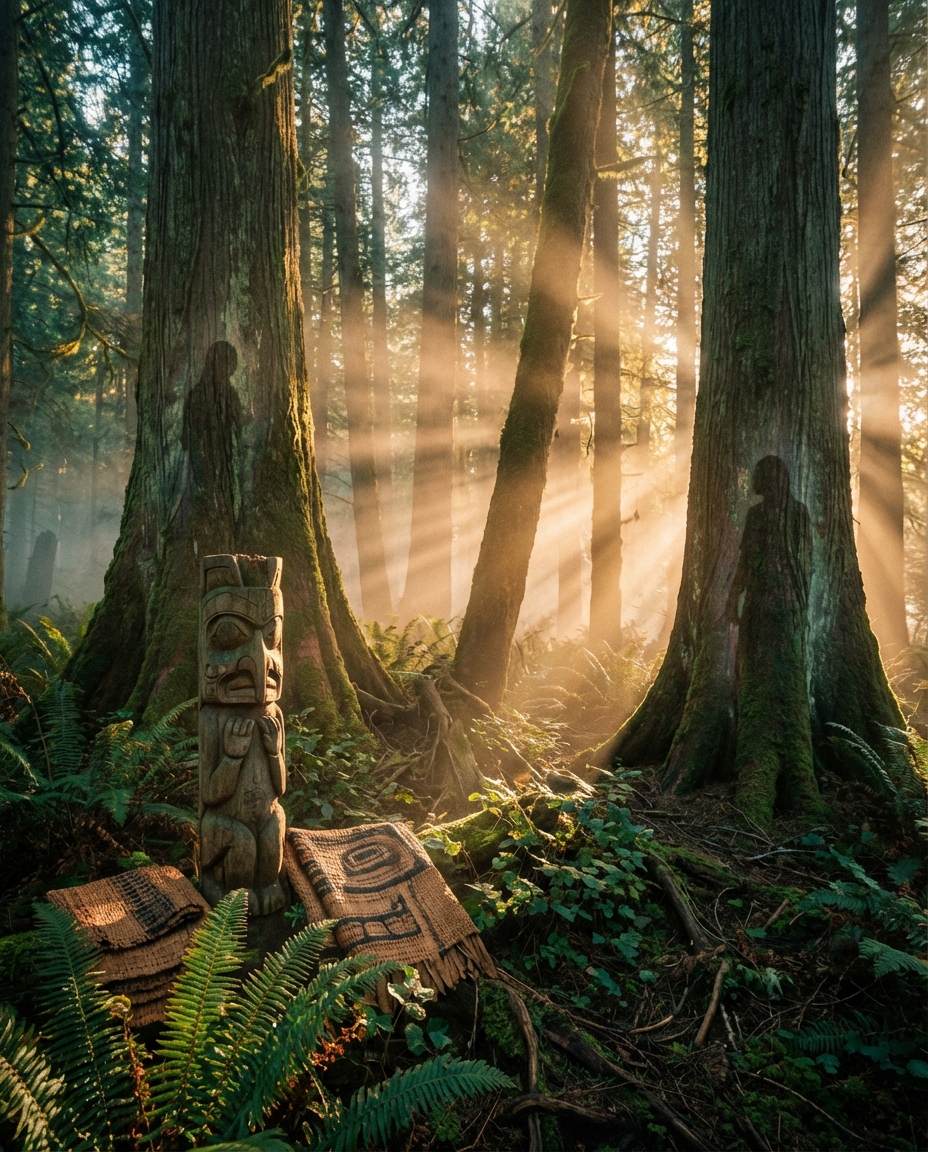
Among many Pacific Northwest nations, one foundational story tells of a man who was exceptionally generous. He gave everything he had to people in need — food, tools, medicine, support. When he died, the Creator transformed him into a cedar so he could continue to help the world forever.
Thus, cedar’s generosity was not metaphorical — it was literal lineage.
This myth reveals two core truths about Western Red Cedar:
Its nature is service.
Its power is relational, not transactional.
Magic worked with cedar must honor reciprocity — you don’t “use” cedar; you partner with cedar.
Cedar as Protector and Purifier
Many traditions view cedar as a guardian spirit that wards off harmful energies, illness, or spiritual interference. When hung above the threshold, cedar boughs serve as spiritual boundary-keepers. When woven into regalia or ritual tools, they create a field of cleansing and clarity.
Its protective reputation echoes across cultures:
Cedar was burned in ancient Mesopotamia to dispel demons.
Cedarwood was considered sacred to the gods in Lebanon’s famed Cedar Forests.
Cedar coffins in Egypt were carved for high-status burials.
Though these species are different, humanity’s instinctive reverence for cedar speaks to a shared intuitive recognition: this tree stands between worlds.
Cedar in Ceremonial Spaces
In many Indigenous traditions, cedar is used:
To prepare people for ceremony
To wash away the heaviness of grief
To welcome new life or honor the departed
To cleanse objects, regalia, and sacred spaces
To accompany prayer for healing or strength
While each Nation’s protocols differ, one theme recurs: cedar is not casual. It appears at pivotal thresholds — beginnings, endings, moments of consequence.
Cedar and the Underworld, Cedar and the Sky
Magically, cedar is dual in nature:
Its roots reach deep into the dark, hidden places of the earth.
Its crown gathers rain and sky energy, feeding the forest.
Thus, it becomes a bridge — a connector of realms. In magical practice, it helps mediate between the physical and the spiritual, the known and the unseen, the self and the ancestors.
III. Magical and Metaphysical Properties of Western Red Cedar
Western Red Cedar carries a spiritual signature that is deep, steady, protective, and purifying. Its energy moves with the same grace as its sweeping branches — wide, encompassing, gently assertive.
Below are its major metaphysical qualities, drawn from both traditional teachings (adapted respectfully for a non-appropriative context) and modern magical correspondences.
1. Purification & Energetic Cleansing
Cedar’s cleansing energy is strong, but not sharp. It doesn’t scorch or overwhelm. Instead, it unravels stagnation, disperses shadow, and restores clarity.
Burned as loose smoke (in cultures that permit this practice), infused into sprays, or used as a floor wash, cedar:
Clears emotional heaviness
Dissolves residual energy from homes or ritual spaces
Removes spiritual debris
Refreshes the auric field
This makes it a powerful ally for healers, diviners, and energy workers who frequently absorb or process the emotional states of others.
2. Protection & Boundary Setting
Western Red Cedar is one of the strongest protective plants in North American magical practice. Its presence creates a container — a quiet but powerful perimeter — that repels harmful forces, spiritual interference, or negative intentions.
Use cedar for:
Home protection charms
Warding doorways and windows
Ritual circles and sacred spaces
Shielding during energy work
Spiritual boundaries for empathic practitioners
Its protection is not aggressive; it is sovereign. It teaches you to hold your ground with dignity and presence.
3. Healing of Body, Spirit & Community
Traditionally, cedar was used for:
Physical cleansing
Restoring strength after illness
Clearing grief
Supporting emotional resilience
Spiritually, cedar works to:
Re-center the mind
Soothe emotional fatigue
Release grief and sorrow
Invite calm after turmoil
It is especially supportive during:
Times of transition
Initiations
Major life changes
New cycles or fresh starts
Cedar teaches restoration through presence, breath, and grounding.
4. Ancestor Work & Spiritual Lineage
Because of its long life and cultural role, cedar is a powerful bridge to the ancestral realm.
It helps:
Open pathways for ancestral connection
Create safe containers for mediumship or spirit communication
Invite ancestral guidance
Honor lineage with integrity
It should be approached with humility in this context — cedar’s ancestral threads are vast and demand sincerity.
5. Strength, Courage & Resilience
Cedar thrives in storms. Its flexible branches yield to strong winds rather than breaking. Its roots anchor deeply. Its bark resists rot.
Magically, it imparts:
Fortitude during adversity
Grounded courage
Emotional resilience
Clarity of purpose
Use cedar in spellwork when you need to remain steady through upheaval.
6. Spiritual Sovereignty & Personal Power
By helping you reclaim your boundaries, cedar invites you into deeper self-sovereignty. It teaches that protection is not isolation but clarity — an alignment of your inner truth with your lived actions.
IV. Herbalism & Practical Use
Before exploring herbal applications, this section must be framed with deep care.
Important Herbal Safety Advisory (Read Before Continuing)
Western Red Cedar contains thujone, a neurotoxic compound. Because of this:
Internal use is not safe and should be categorically avoided.
Do not ingest cedar teas, tinctures, syrups, or internal preparations.
Do not use cedar essential oil internally under any circumstances.
Pregnant people should avoid cedar entirely (internal, topical, or smoke-based).
Thujone is abortifacient and can cause miscarriage.
Cedar essential oil is too strong for most topical uses.
It can cause skin irritation, respiratory issues, or neurological symptoms.
Smoke cleansing should only be done in ventilated spaces and avoided by individuals with asthma or respiratory sensitivity.
Cultural Protocol Matters.
Burning cedar as smoke can be appropriate within some traditions and inappropriate within others. Always respect harvesting permissions, land stewardship, and community teachings where applicable.
This safety framework protects not only the practitioner but also the integrity of the tree itself.
Herbal Uses (Safe, External, and Traditional Context Only)
Historically, cedar was used externally:
In baths for purification or recovery after illness
As a wash for wounds (with careful dilution)
As steam to clear congestion
As a poultice for fungal skin issues
However, modern herbal guidelines recommend limiting cedar to spiritual, aromatic, and low-impact external use, given the known toxicity of its active constituents.
Safe external uses for modern practitioners include:
Cedar hydrosol (from reputable distillers) as a room or aura spray
Cedar-infused oil used as a ritual anointing (not cosmetic)
Cedar boughs added to ritual baths (not for soaking delicate skin)
Cedar boughs placed in the home for cleansing
Floor washes made with cedar tea (used only on surfaces, not skin)
Uses best avoided:
Essential oil on skin (too strong)
Inhalation diffusers with oil (irritating to lungs)
Internal consumption (not safe)
Cedar is potent. A little goes far.
V. Magical Correspondences of Western Red Cedar
Below are correspondences commonly used in modern magical practice, adapted respectfully to avoid conflict with specific cultural teachings.
Element:
Water, with strong secondary ties to Earth
Water: purification, emotional healing, depth
Earth: protection, grounding, longevity
Planetary Ruler:
The Moon, with secondary association to Jupiter
Moon: intuition, cleansing, ancestral connection
Jupiter: protection, growth, benevolence
Zodiac Associations:
Cancer — emotional healing, home protection
Pisces — spiritual connection, intuition
Capricorn — longevity, resilience, ancestral reverence
Gender:
Traditionally viewed as Feminine, though many Indigenous teachings do not gender plants. In modern occultism, cedar’s energy is often described as the Elder Feminine Principle — wise, protective, nourishing, firm.
VI. Deities Associated with Cedar
While Western Red Cedar is specifically tied to Indigenous cosmologies rather than European deities, practitioners often connect its energy to broader magical archetypes.
Appropriate framework:
Cedar itself is a spirit, elder, or ancestor — not merely a commodity.
It should not be culturally re-assigned to European deities in ways that erase its Indigenous identity.
However, in a comparative magical sense, cedar’s qualities resonate with:
Hecate — threshold guardian, cleanser of miasma
Brigid — healer, protector of home and hearth
Freya — strength, sanctuary, sovereignty
Use these resonances carefully and respectfully.
VII. Cedar in Sabat Practices
While not historically European, cedar adapts beautifully into modern pagan sabbat ritual in ways that honor its nature:
Yule:
Cedar embodies endurance through winter’s darkness; perfect for protection charms, boundary-setting, and ancestral veneration.
Imbolc:
Use cedar to cleanse the home or altar as you prepare for renewal.
Ostara:
Cedar baskets or woven pieces symbolize rebirth and resilience.
Lughnasadh / Lammas:
Cedar’s longevity mirrors the themes of legacy, community, and ancestral harvest.
Samhain:
Cedar’s ancestral connections make it ideal for:
Honoring the dead
Setting boundaries in spirit work
Protecting portals or psychic openings
VIII. Working with Cedar Spiritually (Non-Appropriative Ways)
Because cedar holds sacred significance for many Indigenous Nations, respectful engagement is essential.
Here are ethically sound ways to work with cedar:
1. Cultivate relationship, not usage.
Approach cedar with prayer, gratitude, and presence.
2. Harvest only with permission.
Whenever possible, gather fallen branches rather than cutting live ones.
3. Avoid replicating specific Indigenous ceremonies.
Use cedar in your own tradition, not someone else’s.
4. Offer something in return.
Water, song, tobacco (if culturally appropriate), or an act of stewardship.
5. Keep cedar work simple, honest, and intentional.
This tree does not require theatrics; it responds to sincerity.
IX. Ritual Applications & Spellwork
1. Cedar for Cleansing the Home
Place cedar branches:
Above the door
In corners
On your altar
This creates a gentle energy of protection and clarity.
2. Cedar Wards
Create a small bundle of cedar needles tied with natural twine. Hang it above a window or near your bed to keep the aura clean and the spirit grounded.
3. Ancestral Connection Ritual
Place a cedar bough beside an ancestor candle. Cedar helps steady the connection and keeps the space safe.
4. Cedar Bath (External Use Only)
Steep cedar boughs in a pot of water, strain, and add the infusion to a ritual bath. This is cleansing for the aura — not intended for prolonged soaking or sensitive skin.
5. Cedar for Dreamwork
A small sachet under the pillow helps with:
Protection during sleep
Discernment in dreams
Boundary maintenance
X. Western Red Cedar as Teacher
Cedar teaches through presence — steady, unhurried, certain. Its lessons are deceptively simple but transformative:
Hold your boundaries with grace.
Remember where you come from.
Clear the heaviness so you can begin again.
Stand tall, but bend when the wind demands it.
Give generously, but never at the cost of your integrity.
This is the medicine of Western Red Cedar — the wisdom of a being that has watched centuries pass and still rises, still shelters, still speaks.
XI. Final Thoughts
Working with Western Red Cedar is a journey of reverence, responsibility, and relationship. It is not a plant for flashy magic or casual experimentation. Its spirit is old, rooted, and discerning. But for those who approach with sincerity, cedar offers profound gifts: purification, protection, courage, ancestral connection, and the steadying force of a thousand-year-old heartwood.
May your work with Cedar be guided by respect, clarity, safety, and wonder.
May this living cathedral offer you shelter, strength, and insight.
And may its presence remind you of what endures — and what truly matters.